
Teaser
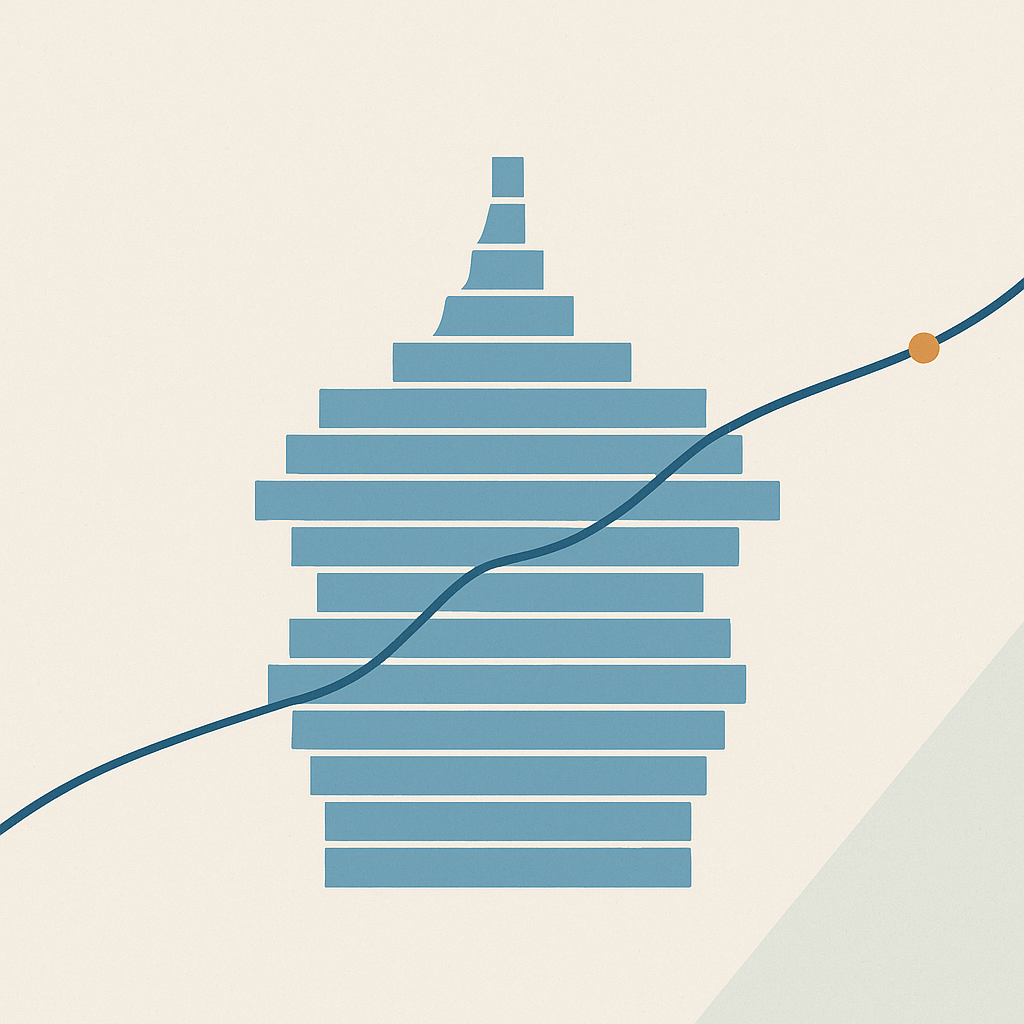
Germany’s population pyramid reads like a condensed social history: two World Wars, a euphoric baby boom, the “Pillenknick”, large migration waves – and now the steep retirement of the Baby Boomer generation. In the 2020s and 2030s, the largest age cohort in German history is exiting the labor market just as fertility remains far below replacement, migration becomes politically contested, and AI begins to transform work itself. This post traces how earlier demographic shocks reshaped labor markets, pensions, migration and politics – and asks what is genuinely new about today’s situation, where chronic low fertility, care shortages, large but unstable migration flows and automation collide.
Introduction & Framing
Germany’s population pyramid tells a story of catastrophe, recovery, cultural transformation, and impending structural crisis. As we approach the 2030s—when the Baby Boomer generation will exit the workforce en masse—it’s worth examining how this demographic shock compares to previous disruptions. What can the wounds of two World Wars, the post-war baby boom, the “Pillenknick”, and successive migration waves teach us about navigating today’s challenges? And crucially: what makes our current situation fundamentally different?
In this post I compare different types of demographic disruption—war, baby boom, cultural shifts in fertility, chronic low birth rates, and large-scale migration—and ask how they reconfigured work, pensions, and political conflicts. The key claim is that current Germany sits at the intersection of three slow-moving forces:
- ultra-low fertility over 50+ years,
- massive cohort retirement, and
- high but politically fragile immigration, now entangled with AI-driven changes to work.
Methods & Approach (Grounded Theory Window)
- Type of article: Conceptual, teaching-oriented essay for BA-level sociology.
- Methodological logic: I treat major demographic events (World Wars, baby boom, Pillenknick, Boomer retirement, migration waves) as “cases” and compare them using a Grounded-Theory style logic:
- open coding: identify key mechanisms (labor shortages, pension stress, migration, automation)
- axial coding: link those mechanisms across cases (e.g. “shock” vs. “structural condition”)
- selective coding: highlight a core theme: demographic shocks are now fused with migration regimes and technological disruption.
- Empirical anchoring:
- Long-run population and fertility trends and projections (Destatis, BiB, World Bank).
- Labour-market and migration projections (IAB, Bertelsmann Stiftung, BAMF, OECD).
- Theory lenses:
- Demographic transition & welfare-state sociology
- Ulrich Beck’s “risk society”
- Hartmut Rosa’s “resonance”
- Assessment target: BA Sociology (7th semester) — Goal grade: 1.3 (Sehr gut).
Historical Shocks in the Population Pyramid
World War I and II: Demographic Catastrophe
The two World Wars left unmistakable scars on Germany’s population structure. World War I claimed approximately 2 million German soldiers; World War II resulted in roughly 5.3 million military deaths and over 2 million civilian casualties. But the demographic impact extended far beyond mortality statistics. The wars created “missing generations”—cohorts of men who never returned to start families, women who never married, children who were never born.
These gaps ripple through the population pyramid even today. The grandchildren of the “missing” 1915-1918 cohort would have been born in the 1970s; the great-grandchildren in the 2000s. Each echo is fainter, but the structural imprint remains.
The Baby Boom (1955-1969): Recovery and Optimism
The post-war economic miracle (Wirtschaftswunder) created conditions for a sustained birth surge. Between 1955 and 1969, German fertility rates climbed well above replacement level, peaking at around 2.5 children per woman. This was driven by economic prosperity, stable employment (particularly for men), traditional family structures, and widespread optimism about the future.
The Baby Boom generation—now aged roughly 56-70—constitutes the largest demographic cohort in German history. Their passage through life stages has shaped German society at every turn: crowded schools in the 1960s, youth culture in the 1970s, labour market saturation in the 1980s, peak earning years in the 2000s, and now—retirement.
The Pillenknick (1965-1975): A Cultural Revolution in Fertility
The introduction of hormonal contraception, combined with shifting gender roles, rising female educational attainment, and the cultural upheavals of 1968, triggered a dramatic fertility decline. Within a decade, the birth rate fell from approximately 2.5 to 1.4 children per woman—a drop unprecedented in peacetime. Germany has remained at or below roughly 1.4–1.6 children per woman for most of the period since the early 1970s.
Unlike the war-induced gaps, the Pillenknick was a structural shift rather than a temporary shock. Fertility never recovered to replacement level. Without migration, the population would already be shrinking more clearly today.
Migration Waves Since the 1950s
From the 1950s onward, migration became the “hidden second demographic variable” in Germany’s story:
- 1960s–70s: Gastarbeiter programmes brought hundreds of thousands of workers from Italy, Turkey, Yugoslavia and elsewhere.
- 1990s–2000s: EU enlargement led to increased intra-European mobility, especially from Eastern Europe.
- 2010s: Refugee movements (especially 2015/16) and EU-internal migration compensated for shrinking domestic cohorts.
- 2020s: War in Ukraine produced another migration wave; net migration temporarily surged, then fell back again.
[HYPOTHESE] Taken together, these migration waves have already postponed the demographic crunch by at least one to two decades compared to a “no-migration” scenario.
What Makes These Events Comparable?
Similarity 1: Labor Market Disruption
Each demographic event created significant labour market imbalances:
- Post-WWI/WWII: Severe labour shortages drove the recruitment of Gastarbeiter in the 1950s-70s; foreign workers and increased female labour participation filled gaps.
- Baby Boom Entry (1970s-80s): The massive cohort entering working age created intense competition for jobs, contributing to youth unemployment and the emergence of the “generation internship” phenomenon.
- Post-Pillenknick (1990s-2000s): Smaller cohorts entering the workforce gradually eased competition, though reunification temporarily reversed this with the integration of East German workers.
- Current Transition (2020s-2030s): The Baby Boom retirement creates unprecedented labour shortages—an estimated 5-7 million workers will exit the workforce by 2035, while far smaller cohorts enter. Migration is already filling part of this gap, but not all.
Similarity 2: Pension System Stress
Germany’s pay-as-you-go pension system (Umlageverfahren) has been stressed by each demographic transition:
- Post-war: The system effectively collapsed and was rebuilt.
- Baby Boom working years: The system thrived with favourable dependency ratios; contributions from a large working-age cohort financed retirees.
- Current transition: The system faces structural crisis as the ratio of workers to retirees approaches 2:1. Here migration matters: younger migrants contribute to pension systems, but only if they are quickly integrated into regular employment and stay long enough.
Similarity 3: Political Salience
Each demographic shift has generated intense political debate about national identity, family policy, immigration, and social security. The vocabulary changes—from Volkskörper to Fachkräftemangel, from Gastarbeiter to Skilled Immigration Act—but the underlying anxieties about demographic decline and “overburdened systems” remain remarkably consistent.
What Makes the Current Situation Different?
Difference 1: Structural Low Fertility, Not Just a Temporary Shock
The World Wars were catastrophic but temporary. The population pyramid eventually normalized through natural demographic momentum. The Baby Boom was a surge followed by correction. By contrast, the Pillenknick initiated a permanent structural shift. Germany has had below-replacement fertility for over 50 years; even optimistic projections do not foresee a return to 2.1 children per woman.
The coming labour shortage is not a disruption to be survived—it’s the new normal to be managed. Without continued net immigration, the working-age population would decline rapidly despite longer life expectancy. Destatis projections show that even under medium migration assumptions the population ages and the labour force shrinks; lower migration scenarios produce much steeper declines.
Difference 2: Automation and AI Change the Labour Equation
Past labour shortages could only be addressed through:
- Immigration
- Increased female labour force participation
- Extended working lives
- Productivity gains through mechanization
The 2020s-2030s add a fundamentally new variable: artificial intelligence and advanced automation capable of replacing cognitive labour, not just physical tasks.
| Decade | Labour challenge | Technological response (simplified) |
|---|---|---|
| 1950s-60s | Post-war reconstruction shortages | Mechanisation, Gastarbeiter recruitment |
| 1970s-80s | Baby Boom oversupply | Limited automation, service sector expansion |
| 1990s-2000s | Reunification shock, structural change | Early digitalisation, offshoring |
| 2020s-2030s | Boomer retirement wave | AI, robotics, cognitive automation |
Automation and migration now interact: firms can choose between recruiting abroad, automating tasks, or relocating production. Policy chooses which combination is attractive.
Difference 3: The Nature of Work Has Changed
The labour market of the 1970s-80s was characterised by:
- Large industrial employers
- Lifetime employment expectations
- Strong union power
- Clear occupational categories
- Limited female participation
Today’s labour market features:
- Service sector dominance
- Precarious employment and platform work
- High female participation but persistent care burdens
- Constant skill obsolescence and pressure for lifelong learning
As a result, the retirement of Baby Boomers doesn’t simply create one-to-one replacement jobs. Many of the roles they leave are restructured, automated, or moved abroad. Migration therefore affects which segments of the labour market are stabilised (e.g. care, construction, logistics, IT) rather than simply “filling all gaps”.
Difference 4: Migration as Lifeline – and Fault Line
Previous labour shortages were addressed partly through migration: Gastarbeiter programmes in the 1960s-70s, European integration in the 1990s-2000s, and refugee flows plus EU migration in the 2010s. Today Germany again relies heavily on migration – but under radically changed political conditions.
- Studies for the Bertelsmann Stiftung and IAB estimate that Germany needs at least around 260,000 net immigrants per year in the long run just to mitigate ageing and maintain economic performance.
- More recent IAB calculations suggest that only with annual net immigration of about 400,000 people can Germany keep its labour force roughly constant up to 2035–2060, even if female and older workers participate more.
- Other scenario studies land in a similar corridor of roughly 280,000–370,000 net migrants per year needed to stabilise the workforce until 2040.
Reality fluctuates around these target numbers: net migration was extremely high in years with exceptional events (2015/16, 2022 with Ukraine), but already dropped again by 2023 and is sensitive to policy changes and global crises.
So how much net immigration do we “need”?
- To slow down labour-force shrinkage: something like 250,000–300,000 net migrants per year may be enough.
- To keep the labour force roughly constant: current IAB work points to around 400,000 net migrants per year on average, over several decades.
All of these numbers are scenarios, not laws of nature; they assume specific participation rates, skill profiles and retention rates. But they give an order of magnitude: without substantial, continuous net immigration, the combination of low fertility and Boomer retirement would shrink Germany’s labour force dramatically.
At the same time, migration has become a political fault line:
- Far-right parties mobilise against immigration, linking it to crime and welfare burdens.
- Employers, trade unions and many researchers stress that “without immigration, Germany’s labour market would collapse within decades”.
[HYPOTHESE] The central political conflict of the 2030s will not be “immigration yes or no” but “what kind of immigration, under what conditions, and with which distribution of costs and benefits between state, firms, and migrants themselves?”
Migration, Labour Markets by Decade
Re-reading the labour-market history through the lens of migration makes some developments clearer:
- 1970s: The Baby Boom arrives – but Gastarbeiter still fill many industrial positions. Migration supports high growth and helps keep wages competitive.
- 1980s: Saturation and stagnation – immigration slows, unemployment rises, and early retirement is used as a labour-market tool.
- 1990s: Reunification shock – internal “East→West migration” combines with international migration; demographic worries temporarily fade behind the systemic transformation.
- 2000s: Precarity and Hartz reforms – EU enlargement brings new migrant workers; the labour market becomes more flexible but also more unequal.
- 2010s: Turning point – net migration clearly stabilises the population; without it, Germany’s population would already be falling. At the same time, migration becomes a central topic in electoral politics.
- 2020s: Great Transition – migration is no longer a “bonus” but a structural necessity to keep the pension and health systems functioning, while AI and automation transform parts of the job structure.
Sociological Implications: What Kind of Society Emerges?
The Care Crisis
One sector where automation offers limited solutions is care work—for the elderly, for children, for those with disabilities. The Baby Boomer retirement doesn’t just remove workers; it adds millions to the population requiring care. By 2035, there will be roughly 6 million people over 80 in Germany, many requiring substantial support.
A large and growing share of this work is already performed by migrants: nurses from Eastern Europe, live-in carers from Poland or the Philippines, doctors from non-EU countries. Migration is thus double-edged: it helps close care gaps in Germany, but sometimes creates shortages in the sending countries.
Care work resists full automation because it requires emotional connection, bodily presence, and culturally embedded judgment. The political economy of care—who provides it, under what conditions, and with which rights—will be central to questions of justice in an ageing, migration-dependent society.
Intergenerational and Transnational Justice
The current pension system was designed when 4-5 workers supported each retiree. With ratios trending toward 2:1, younger cohorts face higher contributions and longer working lives. Migrants often enter the system as contributors in their prime working years, which improves the dependency ratio—if they find stable employment and remain in the country.
Questions of justice become layered:
- Within generations: Which groups (by education, region, migration status) carry which burdens?
- Between generations: How are pension promises and debt distributed between Boomers, Gen X/Y/Z and future cohorts?
- Between countries: When Germany recruits nurses from the Global South to solve its care crisis, whose demographic problem is really being solved?
Ulrich Beck’s “risk society” thesis becomes more complex here: risks are not just individualized within Germany, but also redistributed across borders through selective migration.
Regional Divergence and Migration Corridors
Demographic decline affects regions unevenly. Some rural and eastern regions continue to lose young people despite immigration; others see modest recovery because refugees or EU migrants settle there. Cities with dynamic labour markets attract both internal migrants and internationals, potentially deepening centre–periphery divides.
[HYPOTHESE] Future German demography will be shaped less by a simple “East vs. West” or “city vs. countryside” pattern and more by corridors: regions that successfully combine immigration, integration, and decent jobs will stabilise; others may enter spirals of decline despite overall positive net migration at the national level.
Theory Window: Classics & Contemporary
- Durkheim: Migration and demographic shocks both threaten and renew social integration. Integrative institutions—schools, workplaces, associations—decide whether migrants become part of the “moral community” or remain at its margins.
- Weber: Migration regimes are deeply bureaucratic and legal-rational: visa categories, recognition of qualifications, residence permits. Conflicts arise when formal rationality (strict rules) collides with substantive rationality (what seems fair to migrants, employers or citizens).
- Marx: From a Marxian angle, migrants are often positioned as a flexible “reserve army of labour”, simultaneously indispensable and precarious. This shapes wage levels and bargaining power in specific sectors (logistics, construction, care).
- Beck: For Beck, the combination of demographic ageing, AI, and migration creates new “manufactured risks”: political backlash, failed integration, and global inequalities, all produced by our own modernization choices.
- Rosa: Rosa’s resonance theory draws attention to the qualitative side: can a hyper-aged, digitalised, migration-dependent society still offer experiences of resonance—meaningful relationships in work, neighbourhoods, and politics—for both natives and migrants?
Practice Heuristics: How to “Read” Migration in the Population Pyramid
- Always ask who is moving where. Migration is selective: by age, sex, qualification. A “net +300,000” can mean very different things depending on who comes and who leaves.
- Link migration and institutions. Immigration law, recognition of qualifications, housing policy and education systems decide whether migration actually stabilises the labour market.
- Differentiate short-term surges from long-term trends. War-related refugee waves (e.g. Ukraine) are one thing; stable annual net migration over decades is another. The latter is what matters for pensions and long-run demography.
- Beware of zero-sum thinking. When Germany recruits skilled workers, it may help its own demography but worsen shortages elsewhere. Ethical debates about “care chains” and “brain drain” belong in any serious demographic analysis.
- Combine demographic and migration scenarios. Instead of asking “How old will Germany be in 2050?”, ask “How old will Germany be under different migration regimes (low/medium/high) and different integration outcomes (good/bad)?”
Sociology Brain Teasers
- How would Germany’s population pyramid look in 2050 under three scenarios: low (100,000), medium (250,000) and high (400,000) annual net immigration? Sketch the differences qualitatively.
- Is it fair to actively recruit nurses from countries with their own ageing populations and weak health systems? How would you argue this from a justice-theory perspective?
- In a region with population decline but high refugee settlement, what kinds of new social conflicts and opportunities might emerge?
- Imagine a future where AI automates many white-collar jobs, but construction and care still rely heavily on migrant workers. How would this reshape class structures and political alliances?
- Should migrants who contribute to the pension system for many years receive full pension rights, even if they retire abroad? Why or why not?
- Design a small research project to study whether local voters in high-migration regions perceive immigration more as a threat or as a necessary solution to demographic ageing.
Hypotheses for Further Research
- [HYPOTHESE] Regions that combine high net immigration, good integration outcomes and investment in education will show more stable pension systems and less populist voting than demographically similar regions with restrictive migration regimes.
- [HYPOTHESE] Public support for immigration will correlate more strongly with visible labour shortages in everyday life (closed shops, long waiting times in hospitals) than with abstract indicators such as GDP or dependency ratios.
- [HYPOTHESE] Long-term migrants who arrive between ages 20–35 and stay in Germany for at least 20 years will contribute disproportionately to stabilising the pension system compared to native cohorts of the same size, because they arrive after education and often leave before long pension payout phases.
Conclusion: Lessons and Limits of Historical Comparison
Comparing today’s demographic transition to previous disruptions offers genuine insights:
- Labour shortages are manageable (as post-war reconstruction proved), especially when combined with targeted migration.
- Demographic “problems” can become opportunities (as the Baby Boom initially was, and as some migration waves have been for shrinking regions).
- Cultural transformations in fertility are largely irreversible (as the Pillenknick demonstrated), which makes migration more, not less, important.
- Immigration provides partial solutions but creates political friction and raises new questions of justice, both domestically and globally.
But the comparison also reveals the limits of historical analogy. The convergence of:
- 50+ years of below-replacement fertility,
- the largest cohort retirement in history,
- structural reliance on net migration of roughly 260,000–400,000 people per year, and
- AI automation capable of cognitive labour replacement
…creates a situation without true historical precedent.
The wars were catastrophic but recoverable. The Pillenknick was gradual enough to allow adaptation. The current moment combines structural permanence (no fertility recovery in sight) with acute crisis (the 2025-2035 retirement wave) and technological uncertainty (AI’s ultimate impact unknown), all framed by contentious migration politics.
What’s clear is that the comfortable assumptions of the late 20th century—endless growth, stable employment, secure retirement, demographic normality—are no longer tenable. The society emerging from this transition will necessarily look different. Whether it’s more equal or more stratified, more human-centered or more automated, more open or more closed—these remain political questions, not demographic inevitabilities.
The population pyramid doesn’t determine destiny. But it sets the constraints within which political choices—about pensions, migration, AI, and care—must be made. Understanding those constraints, including the role of migration, is the first step toward making choices wisely.
Literature (APA, selection)
- Beck, U. (1986). Risikogesellschaft: Auf dem Weg in eine andere Moderne. Suhrkamp.
- Bertelsmann Stiftung. (2019). Deutscher Arbeitsmarkt auf außereuropäische Zuwanderung angewiesen.
- Bundesamt für Migration und Flüchtlinge (BAMF). (2024). Migration Report of the Federal Government 2023 – Short Version.
- Institut für Arbeitsmarkt- und Berufsforschung (IAB). (2023). Nur mit einer jährlichen Nettozuwanderung von 400.000 Personen bleibt das Arbeitskräfteangebot langfristig konstant.
- Rosa, H. (2016). Resonanz: Eine Soziologie der Weltbeziehung. Suhrkamp.
- Statistisches Bundesamt (Destatis). (2023/2024). 14. und 15. koordinierte Bevölkerungsvorausberechnung für Deutschland bis 2070.
- OECD. (2024). International Migration Outlook 2024 – Germany Country Chapter.
- Vogel, M., et al. (2023). Future subnational population change in Germany: The role of internal and international migration. BiB.
AI Co-Author Disclosure
This post was co-written with the assistance of an AI language model (GPT-5.1 Thinking) as part of the SocioloVerse.AI teaching and research environment. I provided the core argument, structure, and key claims; the model supported with formulation help, ordering of sections, literature hints and scenario numbers. All empirical statements were cross-checked against official statistics and reputable research institutions (Destatis, IAB, BAMF, OECD, Bertelsmann Stiftung). Responsibility for the interpretation and possible errors remains fully with the human author.
Check Log (Prüfprotokoll)
- Status: Teaching draft v1.1 for introduction-to-sociology.com (migration section integrated).
- Content checks:
- Demographic and migration figures aligned with recent official statistics and major scenario studies.
- Clear statement that net-migration requirements (≈260k–400k/year) are scenario dependent.
- [HYPOTHESE]-Passages clearly marked as hypotheses, not established findings.
- Assessment target: BA Sociology (7th semester) — Goal grade: 1.3 (Sehr gut).
- Open to-dos / next steps:
- Optionally add a simple figure showing three migration scenarios and their effect on the working-age population.
- Consider a short textbox on “brain drain / brain gain” from the perspective of sending countries.
- Date: 27 November 2025.
Leave a Reply